
Kids need Cochlear Implants
(Even though they still kind of suck)

My final semester in college, I took Intro Psychology for my last gen ed. My professor’s area of expertise turned out to be language acquisition in children. His mother was Deaf, and he was fluent in ASL. During lectures, he sometimes went on long, fascinating tangents about Deaf issues.
Infants need language. The good news is that any language will do—spoken, signed, doesn’t matter. But they need at least one, as early as possible. There is a critical window for language acquisition in the infant and toddler years. If a child is not exposed to fluent, native-level language by a certain age, their language skills will be permanently stunted.
Deaf children born to two Deaf, signing parents do just fine. The “language module” in the baby’s brain gets exposed to plenty of stimulation, and the fact that the language is gestural instead of aural isn’t that important. These children are immersed in a language and culture from birth. They can be taught how to understand and read a spoken language later on, in school. They have a foundation to build on.
Meanwhile, deaf children born to two hearing parents do not have access to fluent, native-level sign language. Even if the parents start studying as soon as they find out that their child can’t hear spoken words, they won’t be fluent. There are some features of sign languages that lifelong users do naturally, which adult learners just flat-out can’t do. Half-hearted signs, learned in a mad rush, are not a replacement for the native-level fluency of hearing parents speaking their native tongue. 1
And that’s even assuming the parents care. Sadly, that’s a big if. Typically, these children receive little to no sign language at home, and are then sent to a school for the deaf later in childhood. This is past the critical window. They are “taught” signs in school, and they are “taught” English. They do not actually learn these things. They get passed around and shuffled to the next grade level without understanding, just like we do to kids in regular schools.
My professor cited a statistic that the average Deaf American adult reads English at a 4th grade level. To a layperson, that doesn’t sound too bad. These adults just use ASL most of the time, right?
The answer is no. They have poor skills in English, and they have poor skills in ASL. They missed the critical window to learn fluent language at all.
A cochlear implant is not a magic cure-all with no downsides. The technology is getting better every year, but it still kind of sucks.
Implanting one is literal brain surgery (with all the risks that entails), followed by a months- or years-long adjustment period. The complication rate is an order of magnitude lower than it used to be in the 1990s, but it’s still nonzero.
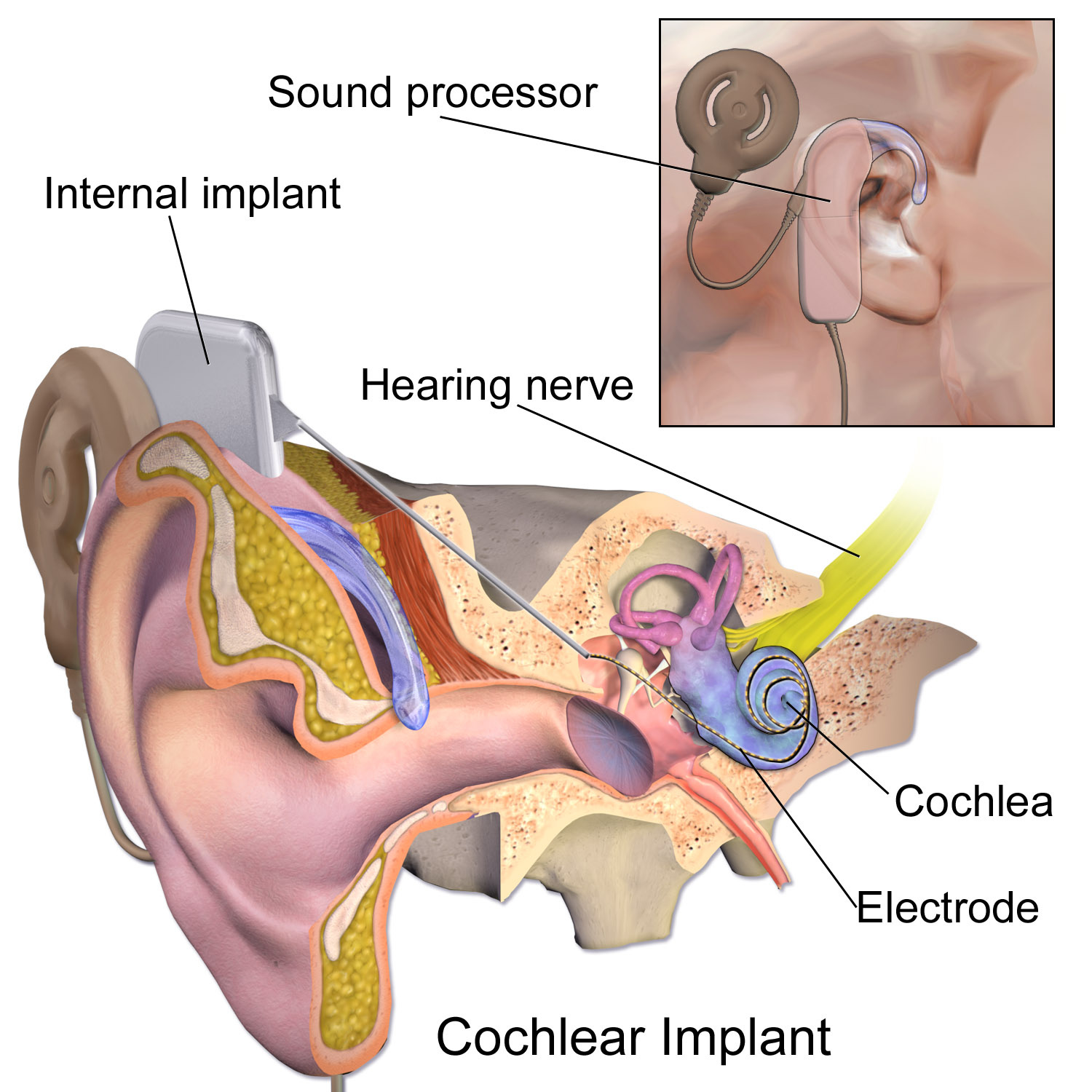
Even if all goes well, they are not a replacement for hearing.
A receiver picks up sound waves from the environment, and the implant translates the signal into electrical impulses for the auditory nerve. The experience that this produces in the brain is nothing like the “sound” that comes from a healthy ear. It’s been described as a mechanical, static-y, garbled, almost underwater-like sensation. It’s not very good for appreciating music or the sounds of the ocean.2
The external components are fragile. Devices break down over time.
And they’re not always possible for every patient. Some types of deafness are caused by certain structural defects that can’t be bypassed with an implant. They’re not perfect, but they’re getting better every year.
But do you know what cochlear implants are good for? Speech. The processing is optimized for spoken words, to the detriment of all else. They give the children of hearing parents access to speech, where they would otherwise have nothing.
Deaf parents do not want to give their babies cochlear implants. The Deaf community, to put it lightly, does not like cochlear implants at all.
I fully understand why they don’t want to give implants to their own children. A lot of this discourse came out of the 1990s, when the complication rate for implants was over 35%.3 Implants still kind of suck today, but decades ago, they sucked so much more.
We have signs, they say. We don’t need spoken language.
Good for them. I really mean that. Given my own membership in a small, insular subculture, I won’t complain about a different small, insular subculture that wants to raise their kids how they want.
But they can only do so because they have a community and a rich social scene—of native signers. These people are all fluent and have well-developed language skills.
Meanwhile, hearing parents overwhelmingly give their babies cochlear implants. Because they don’t have sign language. Not during the critical window that children need. Parents do not want to send their children far away from home to a boarding school for the deaf, to be half-heartedly immersed in a culture that is very different from their own. They do not want their children to have stunted language skills and read at a 4th grade level.
When Deaf parents criticize hearing parents for their decision to raise their children how they want, there is this background assumption that small groups have special status and rights, while large groups do not. Parents within small groups apparently get to raise their children how they wish, while parents within large groups somehow don’t. That is, frankly, absurd. All parents have the right to raise their kids how they want. A group’s size does not dictate whether or not parents within that group suddenly lose the right to transmit their culture down through the generations.
Parents should not have to (hurriedly and poorly) learn an entirely new language for their kids, when there is a technological solution here. Society is fixed; biology is mutable.
Hearing parents want to raise their own children, in their own community, with their own native language. The Deaf community does not have the right to tell other parents, who are not part of the community, to in effect hand over their children to them.
Cochlear implants give children the ability to understand speech during the critical window. Are they perfect? No.
But they don’t have to be.
For example, American Sign Language (ASL) does not have specific signs for pronouns. When people are standing in a cluster, each person’s “pronoun” is just to point at them. If the conversation mentions someone who isn’t present, an arbitrary slice of empty air gets pointed to instead. Everyone in the conversation agrees that that specific point refers to that person for the rest of the conversation. A native ASL user can easily keep track of arbitrarily many locations in space to refer to arbitrarily many people. Someone learning ASL as an adult cannot.
Here’s a simulation of where the technology was in 2011. It’s gotten much better since then, but still not a perfect replacement.
Now, it’s less than 10% for any complication, with the risk of serious complications at less than 1%.
> All parents have the right to raise their kids how they want.
Up to a point, yes. Beyond that point, no. We have a word for that point: "abuse". That word doesn't really have semantic content beyond "those things we as a society have decided that we will not allow parents to do or not do to their children." There are some things that parents should not do to their children, like beating them. There are some things parents must do to their children, like feeding them. And there are lots of things in the middle that are permissible but not obligatory. I'm not a fan of absolute statements about parental rights.
Why not go a step further? It seems like exposing children to language during the critical window might reasonably belong in the obligatory category. Not exposing children to language during the critical window, causing an otherwise cognitively normal child to never develop language skills beyond the 4th grade level, I think maybe we should classify that as abuse. And in the case of a deaf child of hearing parents, it sounds like the only ways to expose the child to language are to ship the child off to a deaf community, or a cochlear implant. So based on your account of the facts, I think I might say that hearing parents of a deaf child are obligated to do one of those two things.